
Reasonable Steps to Find a Defendant: CPR 6.9, Last Known Address and Alternative Service
The short answer
Before you serve a claim form at a defendant's last known address, you must take reasonable steps to find where they live now. That is the effect of CPR 6.9, and a claim served at an address you had reason to think was out of date can be challenged later.
The rule is easy to misread because "last known address" sounds like a default. It is a fallback. The order is: take reasonable steps to find the current address, serve there if you find it, consider an alternative place or method of service if you do not, and only then fall back on the last known address.
This guide is for creditors, landlords and the solicitors who act for them in England and Wales. It explains what each step of CPR 6.9 requires, what reasonable steps look like in practice, how alternative service under CPR 6.15 works, how the four-month life of a claim form affects when you trace, and where a professional trace fits.
Need a current address before you issue or serve?
Start a debtor trace and get the address you need before the clock runs down.
What CPR 6.9 actually requires
CPR 6.9 applies when you are serving the claim form yourself and the defendant has not given an address for service. The rule sets the default place of service by type of defendant:
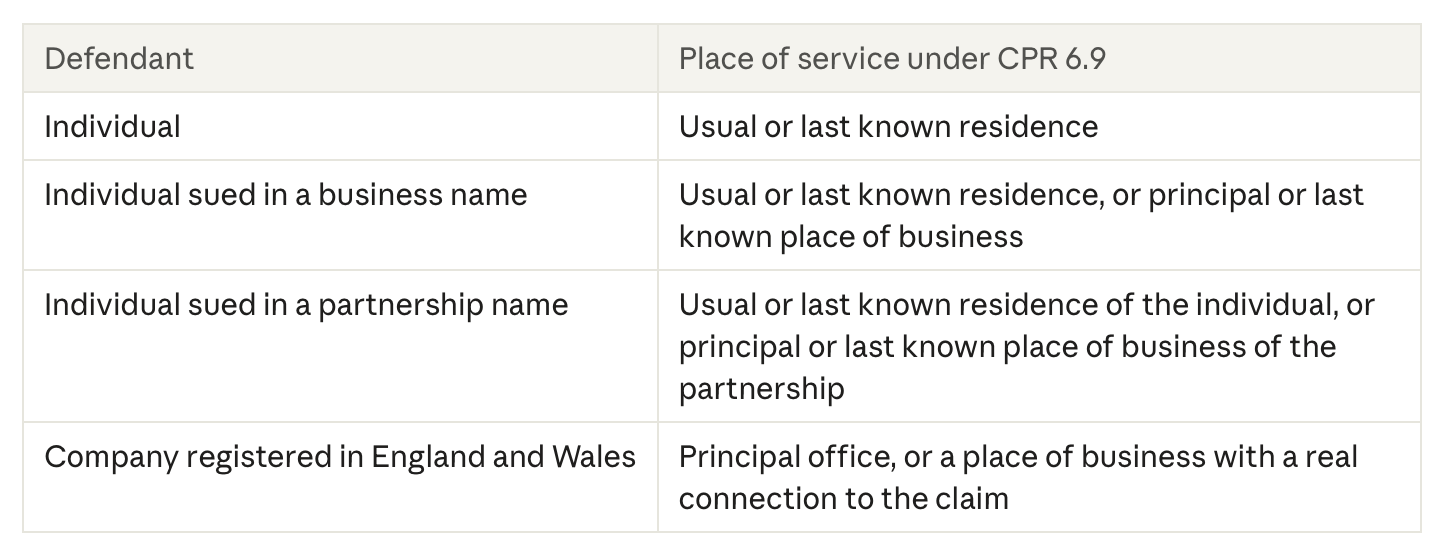
The duty to look for a current address applies to the first three rows: individuals, sole traders and partners. A company is served at its principal office or a connected place of business, so the steps below are mainly about people.
For those defendants, CPR 6.9(3) to (6) work as a ladder:
If you have reason to believe the defendant no longer lives or trades at the address you hold, you must take reasonable steps to find their current address. Returned post marked "gone away", a bailiff's report or a tip-off from a referee all give you that reason.
If you find the current address, you must serve the claim form there.
If you cannot find it, you must consider whether there is an alternative place or method of service.
If there is one, you must apply to the court under CPR 6.15.
Only if you can find neither a current address nor an alternative may you serve at the usual or last known address.
The word "must" runs through that ladder. Practitioners have warned that serving at the last known address without working through it is risky, because a defendant can later argue that service was defective (Civil Litigation Brief).
What reasonable steps look like in practice
The rules do not define reasonable steps, so the court looks at the facts of each case: what you knew, what was easy to check and what you actually did.
The table below is a practical guide to what to try and what to keep, not a legal checklist.
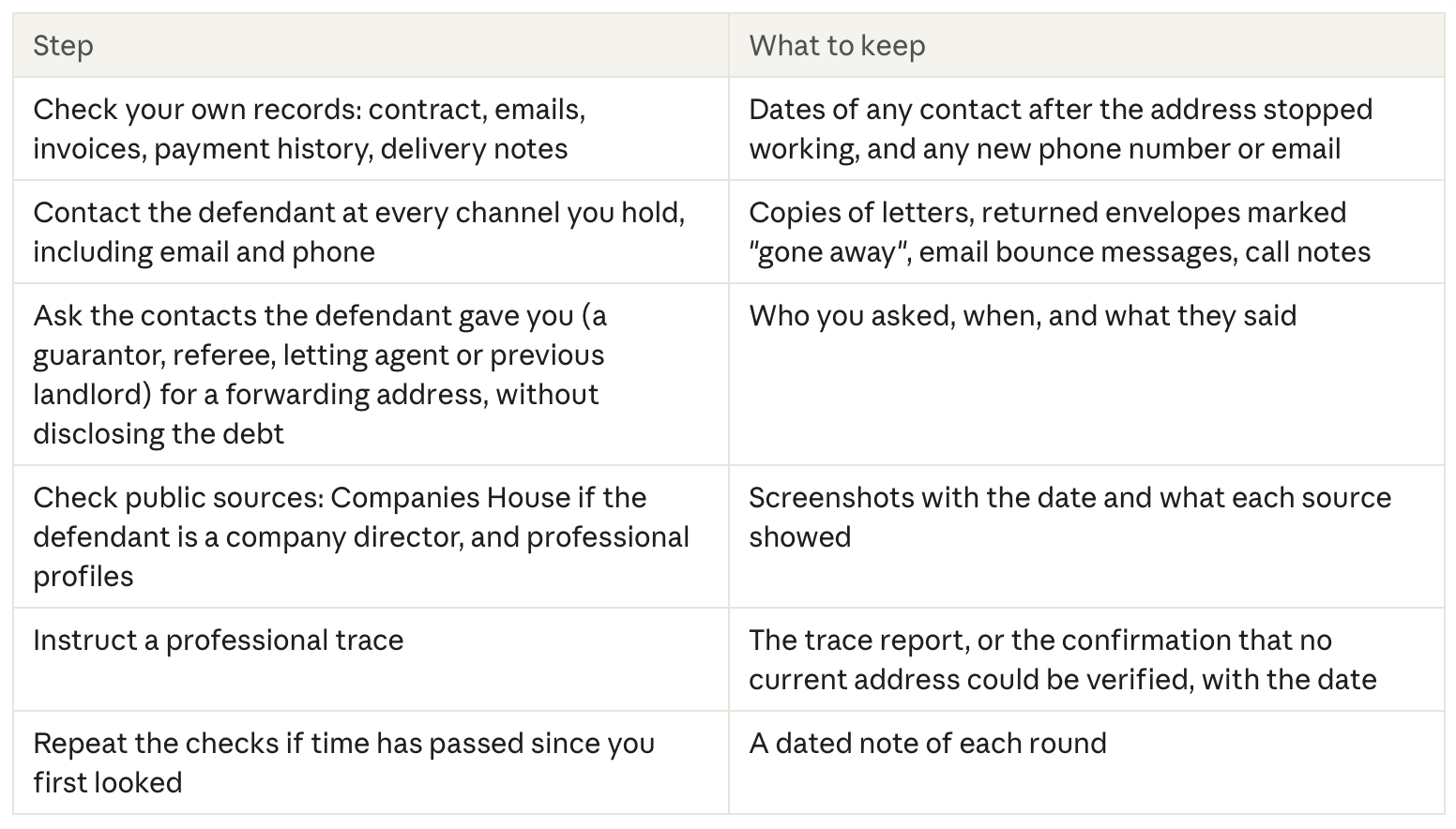
Keep all of it in one dated file. If service is ever challenged, or you need to apply under CPR 6.15, that file is your evidence that you took reasonable steps and what they produced.
The steps matter twice over. A 2021 High Court decision, summarised by Addleshaw Goddard, indicated that whether you took reasonable steps to find the postal address can influence whether the court allows an alternative method of service, even though the two rules are separate.
What not to do
Do not pose as someone else to get information from a bank, employer or neighbour. Obtaining personal data by deception can be a criminal offence under the Data Protection Act 2018. Do not tell an employer or neighbour about the debt, and do not turn up at the defendant's home yourself. Any of these can hand the defendant a complaint and weaken a claim that is otherwise sound.
Alternative service under CPR 6.15
If reasonable steps do not produce a current address, CPR 6.15 lets the court authorise service by a method or at a place the rules do not otherwise allow. The test is whether there is a good reason to do so. The court can also treat steps you have already taken to bring the claim form to the defendant's attention as good service, but it will not do that lightly.
The Supreme Court set out how strict this is in Barton v Wright Hassall LLP [2018] UKSC 12. The claimant emailed the claim form to the defendant's solicitors on the last day it was valid, without their prior agreement to email service. By a majority, the court refused to validate that after the event. Three points from it are worth knowing:
The question is whether there is good reason to validate the method used, not whether you had good reason to choose it.
The defendant learning of the claim is a critical factor but cannot be enough by itself.
A time-barred fresh claim is the kind of prejudice to the defendant that weighs against relief. (Lewis Silkin and HSF Kramer summarise the decision.)
In practice, that points to applying first rather than serving and hoping. Kennedys advises making a prospective application for permission to serve by an alternative method or at an alternative address (Kennedys). Possible alternatives include the defendant's place of work or an email address, but a method only helps if you can show the defendant is likely to receive documents that way.
Email service has its own rule
Outside CPR 6.15, serving a claim form by email requires that the person being served has previously said in writing that they will accept it, under Practice Direction 6A (Capsticks). An email address you found yourself does not meet that. That is why an application is needed.
What the application involves
You apply on form N244 with a witness statement explaining why you do not have the defendant's address, what you did to find it, and why your proposed method will reach them (JustClaim describes the process for claimants). This is where your file of reasonable steps earns its keep.
The court fee depends on how the application is dealt with. Reported figures from 13 July 2026 are £321 on notice and £126 without notice (The Sheriffs Office), so check the current EX50 fee table before you apply.
The four-month clock and when to trace
A claim form you serve yourself must be served within four months of issue, and the step that counts must be completed before midnight on the calendar day four months after the date of issue (CPR 7.5). Every day spent looking for the defendant comes out of that window.
If time runs out, an application to extend is generally expected within the four months, and the court can extend only if, among other things, you took all reasonable steps to serve and acted promptly (CPR 7.6, as described by Solicitors Journal and i-law). Dispensing with service altogether is possible only in exceptional circumstances (CPR 6.16). Treat both as last resorts.
The practical rule is to start early:
Check your own records and the returned post as soon as you suspect the defendant has moved.
If you have just learned of a move, allow time before tracing. We recommend waiting about four weeks after the move date so that credit agency data reflects the new address.
Instruct the trace in the first weeks of the claim form's life, not the last. Our normal turnaround is seven working days, and it can take up to 30 for complex cases.
If an address comes back, serve there. If it does not, you still have time to apply under CPR 6.15 with your evidence in hand.
When you issue, you can tell the court that you will serve the claim form yourself. Otherwise the court serves it. Serving it yourself gives you the full four months to find the address and arrange service.
Where a professional trace fits
A professional trace is the step that most often turns "gone away" into a current address you can serve. You give us the defendant's full name and their last known address or date of birth, and we search credit agency data and supporting research to find where they live now. Our legal claim tracing service is built for solicitors and creditors preparing to serve.
Traces start at £49 + VAT, with Standard at £69 + VAT and Premium at £99 + VAT. A £20 add-on covers telephone and email, and a £100 add-on covers telephone, email, CCJ data, OSINT research and property or asset information. Premium includes a free 60-day retrace, which is useful if service is delayed and you want the address revalidated before you rely on it. Standard includes 30 days.
Two things to know before you instruct.
We check every request. We verify your ID, take a signed statement of why you need the address and screen each case manually. A claim or judgment gives you a clear legitimate interest. We do not trace relatives, ex-partners or anyone you have a personal relationship with.
No trace, no fee, and no report. If we cannot verify a current address, we refund you in full and do not issue a report. If you need a record of your own attempts for a CPR 6.15 application, keep your file of steps as described above.
A successful trace gives you a current address as shown on credit agency data and supporting research. It is not a guarantee that the person is still there on the day you serve, so serve promptly or use a retrace.
Have a claim to serve and no current address?
Start a debtor trace and move to service with the address you need.
Frequently asked questions
What are reasonable steps to find a defendant's address?
CPR 6.9 does not define them, so it depends on the facts. In practice, steps that cost little and are likely to produce an address come first: your own records, contact attempts, referees and guarantors, public sources and a professional trace. Keep a dated record of each, because that record is your evidence.
Can I just serve the claim form at the last known address?
Only as a last resort. If you have reason to believe the defendant has moved, you must first take reasonable steps to find the current address, and consider alternative service if you cannot. The last known address is available only if you can find neither a current address nor an alternative.
What if I cannot find the defendant at all?
Consider an alternative place or method and apply under CPR 6.15, with evidence of the steps you took. Dispensing with service is possible only in exceptional circumstances, so it is not a plan to rely on.
Does this apply to a company defendant?
The duty to look for a current address applies to individuals, sole traders and partners. A company registered in England and Wales is served at its principal office or a place of business with a real connection to the claim.
How much does it cost to apply for alternative service?
You pay the court fee for an N244 application, which depends on whether it is dealt with on notice or without notice. Check the current EX50 fee table. You may also have legal costs if a solicitor prepares the witness statement.
Does a trace guarantee that service will be good?
No. A trace gives you the current address as shown on the data at the time of the search. You still have to serve in the way the CPR requires and within the life of the claim form. If time passes, a retrace revalidates the address.
Is it legal to trace a defendant?
Yes, where the person tracing has a lawful basis, such as a legitimate interest in pursuing a claim, and the work is done properly. We screen every request and do not trace relatives, ex-partners or anyone you have a personal relationship with.
Does this apply in Scotland and Northern Ireland?
No. This guide covers the Civil Procedure Rules in England and Wales. Scotland and Northern Ireland have their own rules.
About this guide
This guide is general information for England and Wales, not legal advice. Court rules and fees change, so check the current Civil Procedure Rules and the EX50 fee table, and take advice from a solicitor on your own claim.