
How to Enforce a CCJ when the Debtor has Moved Address.
A CCJ only pays out if you can reach the debtor, and every enforcement route in England and Wales needs a current address. When the debtor has moved, your judgment stalls until you find them and their current address.
It is a common and frustrating position. You have done the hard part: you made the claim, won the judgment, and the debtor still has not paid. Then your post comes back marked "gone away", or a bailiff reports that the debtor no longer lives at the property. The court will not trace the debtor for you, and the judgment does not follow them to their new home.
This guide explains what to do next. It covers the four main ways to enforce a CCJ (a warrant of control, attachment of earnings, a charging order and a third party debt order), the court fee for each, and why each one needs a current address. It also covers what you can check yourself for free, what you must not do, and when a professional trace is the quicker and safer way to get the address you need.
It applies to county court judgments in England and Wales. Scotland and Northern Ireland have their own enforcement systems.
Have a CCJ and no current address?
Start a debtor trace and get the address you need to move to the next step.
Why a moved debtor stalls your CCJ
A county court judgment (CCJ) is an order to pay. It is not a collection service. The court will not chase the debtor for you, and it does not track them when they move house.
If you have a judgment and the debtor has left the address on the claim form, you will usually see one of three things. Post comes back marked "gone away". A bailiff visit ends with the warrant returned unexecuted. Or the court cannot serve a new application on the debtor.
None of that cancels the debt. You can still enforce a judgment for six years without asking the court's permission, so the clock matters. But the next step depends on knowing where the debtor lives now and in some cases where they work and what they own.
Your enforcement options, and why each one needs an address
There are four main ways to enforce a CCJ in the county court. Each one fails or stalls without a current address, as the table shows.
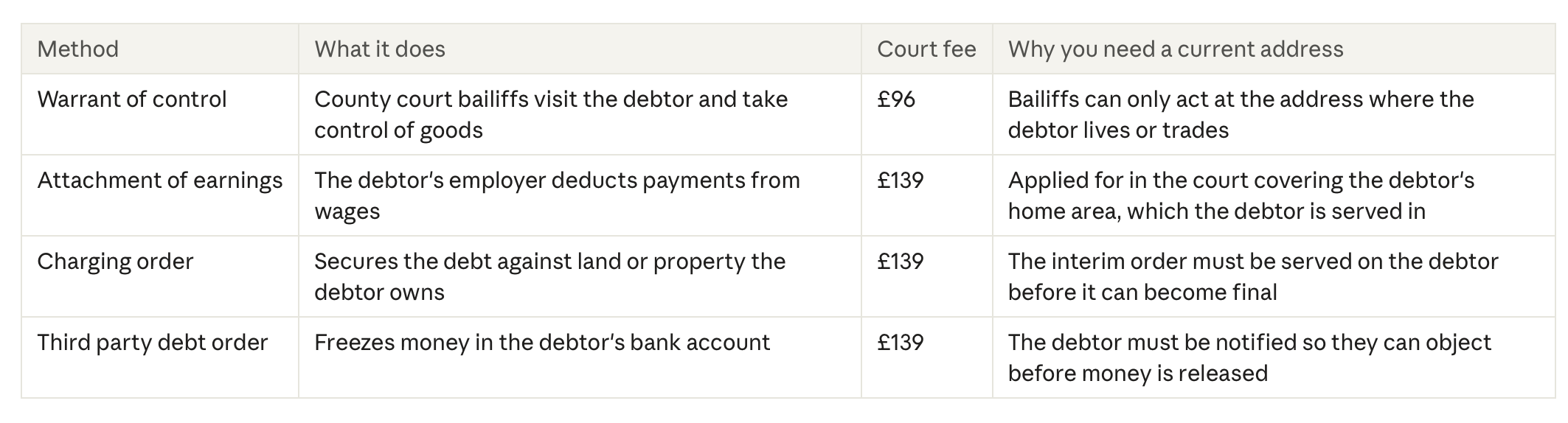
*Fees are the civil court fees published on GOV.UK in October 2026. Check the current EX50 fee table before you apply.
Warrant of control
This is the most common first step. A warrant of control sends an enforcement agent to the debtor's address to collect payment or take control of goods. If the debtor has moved, the visit achieves nothing and you pay the fee again to try the new address. For judgments of £600 or more that are not regulated by the Consumer Credit Act, you can ask the court to transfer the case to the High Court so a High Court enforcement officer can act. That also needs a correct address.
Attachment of earnings
This works well for debtors in steady employment because payments come straight from their wages. It does not work for the self-employed. You need to know the debtor is employed, and the application goes to the court that covers where they live, so a wrong address can send it to the wrong court.
Charging order
A charging order secures your debt against property the debtor owns, and it can later lead to an order for sale. It suits debtors who own a home, and you can check ownership with the Land Registry. The debtor still has to be served with the interim order, so a charging order does not remove the need to find them.
Third party debt order
If you know where the debtor banks, a third party debt order can freeze the money in the account. The bank is served first, then the debtor, who has a chance to object. It only works if the account holds money on the day it is served, so timing matters.
What to check yourself before paying for a trace
A few free checks are worth ten minutes, and they will tell you whether you need a trace at all.
Your own records. Look through emails, invoices, delivery notes, and any contact from the debtor after the judgment. A forwarding address or new phone number is often sitting in your inbox.
The returned post and the bailiff's report. A "gone away" note, or a warrant returned with a comment from the agent, can show when the debtor left and sometimes where they went.
Companies House, if the debtor is a company director. The public register shows the company's registered office and the director's service address. A director's home address is not public, so this will not always get you there.
Public profiles. A current employer on LinkedIn or a business website can point you to attachment of earnings, even if you still lack a home address.
What not to do
Do not pose as someone else to get information from a bank, employer or neighbour. Obtaining personal data by deception can be a criminal offence under the Data Protection Act 2018. Do not tell neighbours or an employer about the debt, and do not turn up at the debtor's home yourself. It can expose you to a harassment complaint and damage a claim you have already won.
If these checks do not give you a current, reliable address, a professional address trace is the faster and safer route.
How a debtor trace works, and what it costs
A debtor trace finds a current address for someone you already have a legal claim against. You give us the debtor's full name and their last known address or date of birth, and we search for where they live now.
A judgment gives you a clear legitimate interest in finding the debtor, but we still check every request before we search. We verify your ID, take a signed statement of why you need the address, and screen each case manually. We do not trace relatives, ex-partners or anyone you have a personal relationship with, and we decline cases that do not pass.
A basic address trace starts at £59 + VAT. If you want to contact the debtor before you enforce, you can add a telephone number or email address, and CCJ data is available as an optional extra. Compare that with a warrant of control sent to an address the debtor has already left: you pay the £96 court fee and collect nothing.
Have a CCJ and no current address?
Start a debtor trace and get the address you need to move to the next step.
Once you have the address: what to do next
Work through the options in order of cost and likelihood of payment.
Check how the debtor is paid and what they own. An employed debtor points to attachment of earnings. A home owner points to a charging order. Neither is certain, so use the trace to decide where to spend the court fee.
Ask the court to enforce at the new address. If a warrant was returned unexecuted, you can ask for it to be attempted at the new address instead of starting again.
Consider an order to obtain information. This requires the debtor to attend court and answer questions about their income, employer, bank accounts and assets, which helps you pick the right method.
Move fast. Debtors who have moved once often move again, and a bank account you know about today may be empty next month.
The six-year point
You can enforce a CCJ without the court's permission for six years from the date of judgment. After that you need to apply for permission first. Interest on the judgment can also be recoverable, so check the position on your own judgment before you decide how much to claim.
Frequently asked questions
Can I enforce a CCJ if the debtor has moved?
Yes, but you need their new address first. The judgment stays valid, and you can enforce it for six years without the court's permission. Each enforcement method needs the debtor's current address, their employer or their assets, so tracing them is usually the first step.
Can the court give me the debtor's new address?
Not as a routine service. The court holds the address on the claim form and will not search for the debtor. You can ask for a warrant to be attempted at a new address once you have found it yourself.
How long do I have to enforce a CCJ?
Six years from the date of judgment without permission. After six years you must apply to the court for permission to enforce.
Which enforcement method is best?
There is no single best method. A warrant of control suits debtors with goods at a known address, attachment of earnings suits employed debtors, a charging order suits home owners, and a third party debt order suits debtors with money in a known bank account. A trace shows you which applies.
Is it legal to trace a debtor?
Yes, when the person tracing has a lawful basis such as a legitimate interest in recovering a debt, and the work is done properly. A judgment strongly supports that basis. Tracing a partner, ex-partner or relative for personal reasons is a different matter and is not something we do.
Have a CCJ and no current address?
Start a debtor trace and get the address you need to move to the next step.